Journal
Handmade vs Machine-Made Crochet: How to Tell Quality Apart
Can crochet be made by machine? Learn the difference between handmade crochet and factory knits, the signs of quality, and what to ask before you buy.
Lovely Admin·Published ·5 min read
Search a marketplace for a crochet bag or cardigan and you’ll see prices that differ tenfold. Some pieces are handmade, some are machine-made, and some aren’t crochet at all. The trouble is that product photos aren’t always honest about which is which.
This guide helps you tell handmade crochet from factory products, judge the quality of a crochet piece, and know what to ask a seller before you buy.
Crochet and knitting are not the same
In Indonesia, the word “rajut” covers two different techniques.
- Crochet. Uses a single hook and forms loops one at a time. This is what we do in our studio.
- Knitting. Uses two long needles and makes a thinner, stretchier fabric, like most jumpers.
This matters because knitting can be done by machine, but true crochet almost can’t. To this day there’s no machine that reproduces the motion of a crochet hook to make crochet fabric from start to finish. So if a product really is crochet, a person almost certainly made it, whether in a small studio or a workshop with many makers.
What’s often sold as “factory crochet” is usually machine knitting, or a fabric printed or woven to look like crochet.
7 ways to tell handmade crochet from factory products
1. Look at the stitches
Crochet looks like rows of small stacked knots, with a raised, slightly thick texture. Machine knitting looks like rows of tiny, very even “V” shapes, flat like T-shirt fabric. If the surface is too smooth and uniform, it’s probably a machine knit.
2. Notice the small imperfections
Handmade crochet has small variations. A stitch might be a touch looser, or one granny square a millimetre or two different from another. That’s not a flaw. It’s the maker’s signature. Machine products are perfectly uniform from end to end.
3. Check the inside and the seams
Turn the piece inside out. On handmade crochet you’ll see neatly woven-in ends and hand-sewn joins between parts. Machine products usually have overlocked seams with thin sewing thread that’s different from the yarn.
4. Give it a gentle tug
Crochet is sturdier and stretches less because every loop locks into the next. Machine knits are much stretchier. If the fabric stretches easily like a T-shirt, it’s knitted.
5. Look at the label and the yarn
Sellers of handmade crochet can usually tell you the yarn type, its weight and the hook size used. Factory products often just say “knit” or “crochet” with no detail.
6. Compare the price with the time
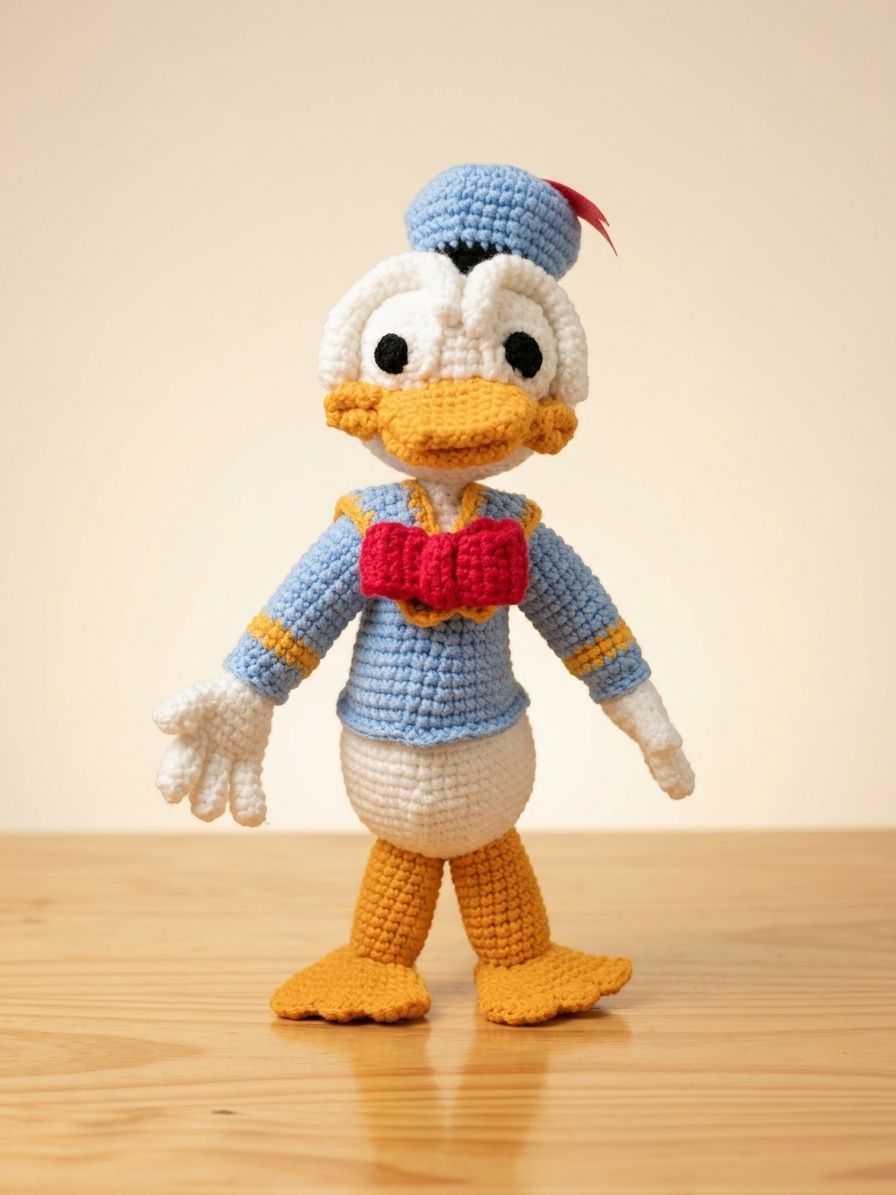
A large doll like our Donald Duck takes a dozen or more hours. A granny square shoulder bag has nine squares, each taking about 30–45 minutes, plus time to join them and make the strap. If a similar bag sells for less than the cost of its yarn, something has been cut, whether yarn quality, size or the maker’s wage. See our time breakdown in how many hours one doll takes.
7. Ask about customisation
Handmade crochet can almost always be customised, from colours and size to an added name. Factory products only come in the variants already produced.
Signs of good handmade crochet
Not every handmade piece is automatically good. Here’s what we check before anything leaves our studio.
- Even tension. Stitches are the same size from start to finish, with no sudden loose or tight patches.
- Dense where it matters. You can’t see the stuffing through a doll’s stitches, and a finger can’t easily poke through a bag.
- Hidden ends. No dangling yarn. Ends are woven in three directions so they can’t unravel.
- Strong joins. Doll parts don’t wobble when gently pulled. Bag straps are double-stitched.
- Symmetry. Ears, arms and granny squares match.
- Stable shape. A bag stands upright, a bouquet doesn’t droop, and a cardigan sits neatly on the shoulders.
- The right yarn for the job. Soft yarn for babies, strong yarn for bags, cool yarn for hats.
Questions to ask before you buy
- Is it crochet (hook) or knitted (needles)?
- Is it handmade or machine-made?
- What yarn is it, and how do I care for it?
- What are the exact measurements in centimetres?
- For children’s dolls: are the eyes embroidered, or plastic with locking backs?
- Can I customise the colour or size?
A seller who really makes their own pieces is usually happy to answer all of these in detail.
Are factory products always bad?
No. Machine knits have their place, like a light, affordable jumper for everyday wear. Problems only arise when machine products are sold as handmade at handmade prices, or when buyers expect handmade quality at mass-market prices.
What matters is knowing what you’re buying. Handmade crochet offers something a machine can’t: a piece made for one particular person, with details you can choose and a story behind it. That’s why handmade crochet is so often chosen for important moments, like a graduation gift or an anniversary gift.
In short
Next time you see a “crochet” product, take a minute to look closely at the stitches, turn it inside out and ask the seller a few questions. You’ll know exactly what you’re paying for.
To see handmade crochet up close, open the product photos in our amigurumi collection. Tap a photo to zoom in.